Exhibition 

Exhibition

Image to Image: Dominik Lejman | Step Aside

In this edition of Image to Image, we extend our platform to connect with our current exhibition, Dominik Lejman - Step Aside.

Dominik Lejman is known for his innovative hybrid works that emerge from the fusion of chiaroscuro-painted canvases and video projections. For creating his unique visual realms and redefining the medium of painting, Lejman was awarded the prestigious prize of the Akademie der Künste in 2018.
 
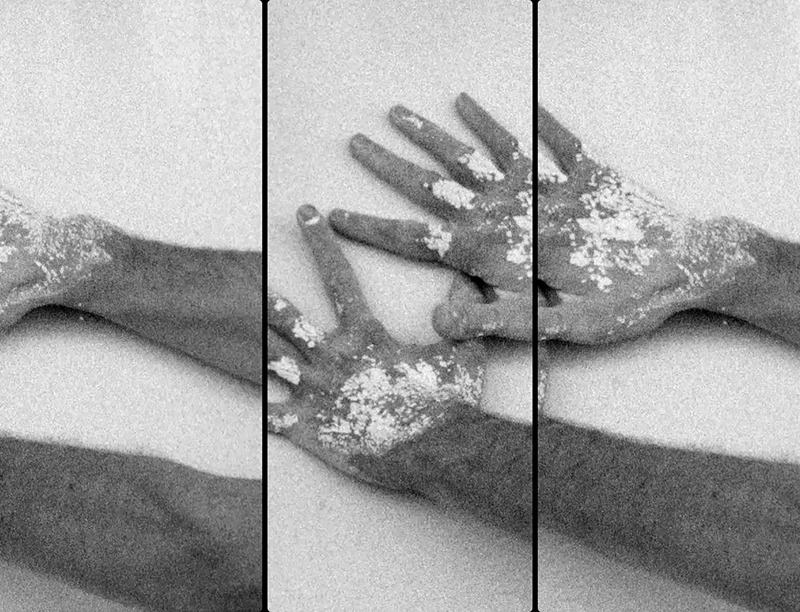
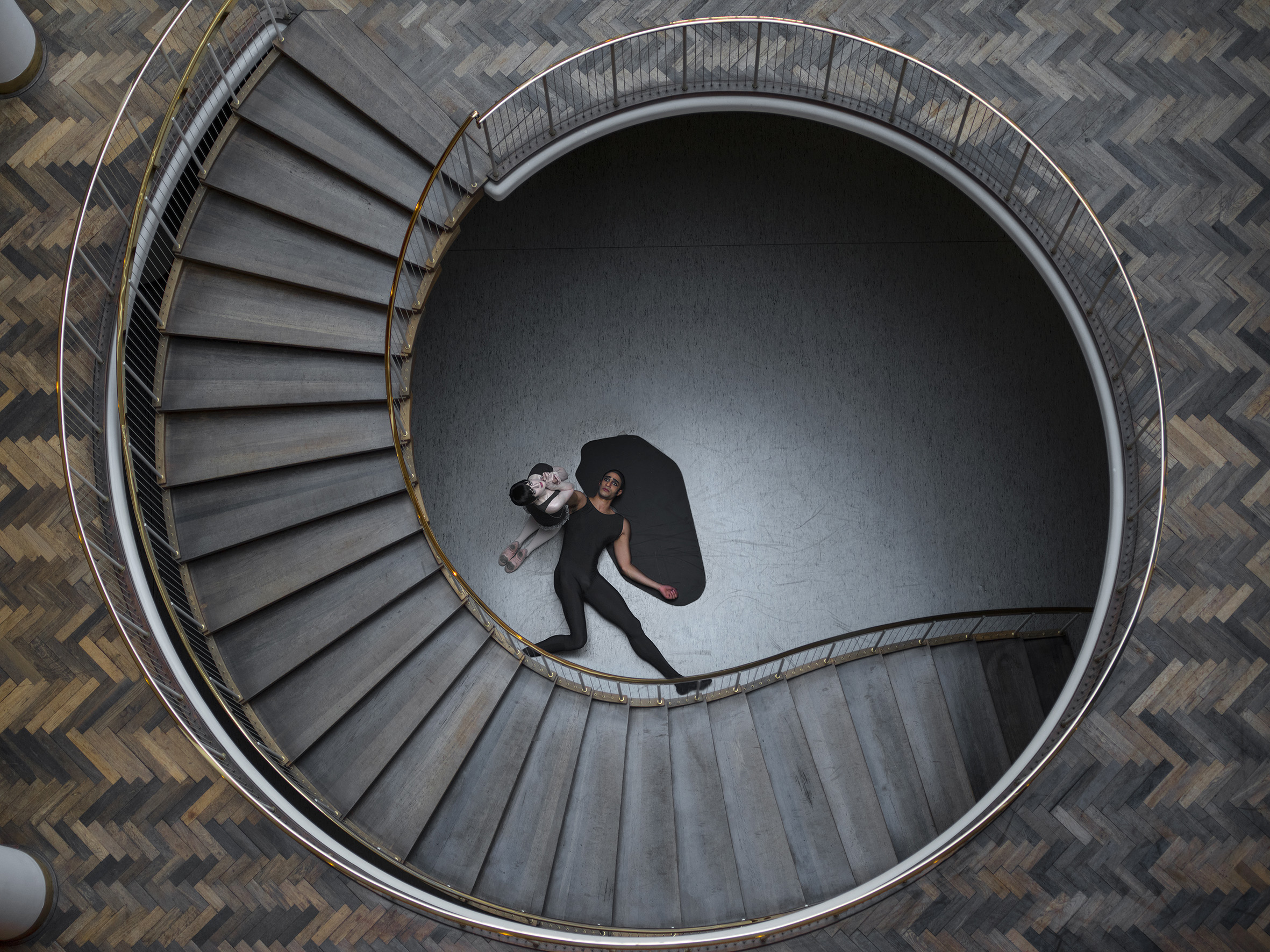
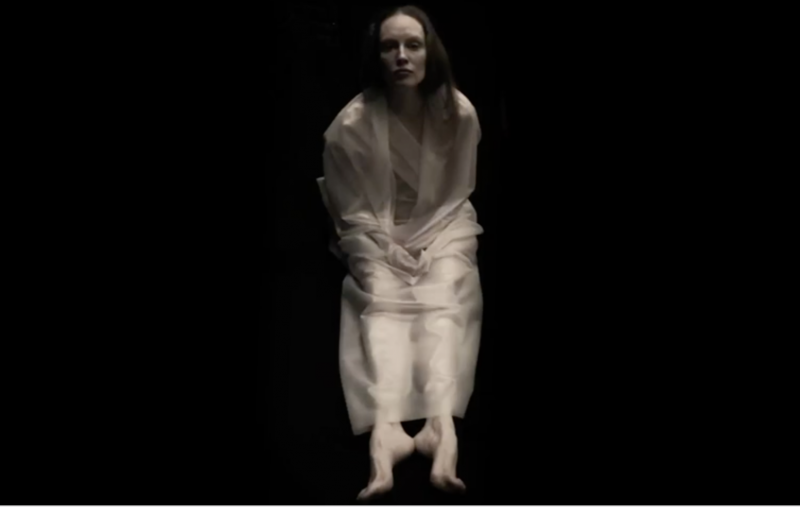
For the project titled Reenactment Lejman started a collaboration with the British performer and model Bianca O’Brien. Initially created as part of the off-Venice Biennale pavilion "Madnicity” in 2022, the series displays a constructive discourse on stereotypes and common beliefs about mental disorders. With themes cantered around the concepts of control, manipulation, and submission to beauty cannons, Reenactment also deals with the distinction between normality and insanity as well as the marginalization of those we judge to be mad. Lejman paired up his paintings with ephemeral ghostly scenes of a female figure, based both on religious representation in art history and photographic archives of the former mental hospital at San Servolo. The body is being presented as an object, directed frontally by a pair of hands, wrapped in a white cloth reminiscent of a straightjacket – a cloth taken directly from the Baroque tenebristic painting. Set within a black void that lend his work a certain baroque quality, his figures often appear like dolls or puppets that remain mostly passive in their own actions. The ephemeral projection emphasize the innovative hybrid form of Lejman’s works – stressing the absence of representation. Leaving behind the canvas to be looked at, ‘the projected absence’ makes it evident that the painting is far more than just the projection surface


Screendance 2.0: Glitch Bodies ou le Corps Morcelé


Stefan Panhans, Freeroam À Rebours, Mod#I.1, videostill.


A man dancing barefoot in the forest lifts one leg and circles it towards the edge of the frame, continuing its motion fluidly into the next shot, where it lands softly on the floor of a furnished studio. With the same ease, he pirouettes from the domestic space into that of a museum hall and continues dancing among Greek statues, until with a great leap —seen from below— he jolts back into the forest, landing firmly on both feet.


In her pioneering Study in Choreography for Camera (1945), dancer, choreographer and filmmaker Maya Deren realized her vision of liberating the body from the confines of space, creating "a new geographical reality, where great distances can be covered within the span of just four minutes” (Higgins, S., Still Moving, 2006). In many ways, this early work of "screendance” (or "choreocinema” as one critic called it) prefigures what only decades later became part of everyday experience: one of constant dislocation within and between the virtual spaces of a hyperconnected world. Screendance continued to develop as a subgenre of experimental video art throughout the 50s, 60s and 70s, popular especially among artists exploring new conceptions of the body, who by the use of recording media and editing technologies rendered the body no longer subject to its own flesh-bound vagaries, but rather to the one-eyed frame, through which anatomized pieces were cut apart, rearranged, and "recorporealized” (Bahhi, R., Screendance, 2014): The moving body reborn as moving image.


But screens are not what they used to be; Arguably more addictive, exhilarating, numbing, liberating, suffocating, and certainly more ubiquitous and diverse than ever, the phrase "the moving body reborn as moving image” resounds altogether differently today. Whether one fondles Legacy Russell’s high hopes for the liberating potential of the "the Glitch Body” for (gendered, racialized, classed) bodies in virtual space, or rather dreads Lacan’s corps morcelé ("the fragmented body”) as a source of anxiety and torment, we could at least agree: Perhaps we’ve all become performers in a (bad) screendance u/dystopia.


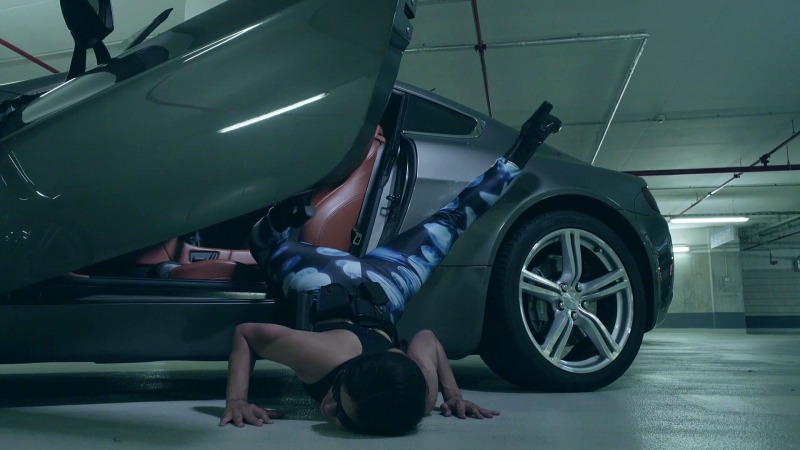
Screendance 2.0 looks at how contemporary artists are "doing” screendance today, and how they pick up on or reshape this tradition to mediate the increasingly varied ways through which we inhabit our own, as well as other bodies (living and nonliving, past and present) through screen/lens-based media. By offering multiple, fragmented, partial, dismembered, and transposed views onto the dancing body, as well as by actively involving the camera in the choreography itself and implicating screens also in facial-recognition, motion-capture, gamification, and avatar-control, these works explore shifting senses of bodily perception and open new views into how our psychosomatic experience is reconfigured in a (digital/virtual) era of screens galore.


Isabel de Sena

Screendance 2.0: Glitch Bodies ou le Corps Morcelé
All the Pretty Landscapes

All the Pretty Landscapes

As in the third Image to Image, this current edition also looks at humanity’s responsibility to our environment. Genesis 1:28 counsels us to subdue the Earth. Which we have done, oh so thoroughly – at the latest by the time agriculture was invented, and in earnest since the Industrial Revolution. But does subdue really mean "exploit”? Or perhaps He meant a sensitive reclamation, as contemporary Hebrew exegesis would translate it, much like one cultivates and tends the land? There’s no arguing with the fact that we’ve overreached and now face catastrophe. We all know it and we’re looking in every direction for a way out, but we also have to admit that we’ve become accustomed to this sense of destruction, and the dying out of many species. The vast majority of us have never seen, much less experienced, pristine nature untouched by humanity. On the contrary, we’ve learned to find aesthetic charm in over-cultivated, industrialized landscapes, and can even discern an aesthetic attraction in utterly devasted natural landscapes. Restricted zones and the decrepit nuclear facilities are to us now what artificial ruins were to eighteenth-century English landscape gardens. Nowadays, every computer game showcases dystopic post-apocalyptic scenes. We have always been fascinated by landscapes such as deserts, not only as havens for fanatic esoteric freaks, but also as atmospheric attractions for the tourist package safari holidaymakers. They couldn’t care less whether all the sand is the result of climate change or not. Who knows what it was like before? And anyway, let’s be honest: we never did like those little creatures and insects all that much.
But let’s not spoil the mood. Let’s be grateful for those individuals who’ve devoted themselves to fighting climate change. Even if it sometimes feels as though they’re tilting at windmills. And hey: let’s enjoy the crisp Riesling that the Scandinavians are finally in a position to cultivate.

Olaf Stüber


Love Letters from a Burning Building


"Everything that can be said about the apocalypse is already anachronistic, and everything that can be done about climate change is by definition too little too late." With this statement Déborah Danowski and Eduardo Viveiros de Castro indirectly confront the geological time with the human time—two antagonistic temporalities that rarely merge (The Ends of the World, 2016). Organizing a long-term action that transcends the individual lifetime of the human agents and spans across different generations consistently could provoke a change, but what are the odds for this to happen? Action seems to be done and subsequently undone with increasing velocity, mainly depending on which interests are at stake in that particular moment. To make and unmake, to create and delete, to sign and countersign. Sometimes, we are left wondering whether the only reasonable action would be a calm mourning of the future loss (therefore non-action). Elizabeth Kolbert stated that what is sometimes labeled as neocatastrophism, but is mostly nowadays regarded as standard geology, holds that conditions on earth change only very slowly, except when they don’t (The 6th Extinction. An Unnatural History, 2014). And so we move forward in our linear time, traversing ‘periods of boredom occasionally interrupted by panic’.

Love Letters from a Burning Building departs from the increasingly pervasive feeling of an 'imminent end' and its subsequent slightly paralyzing effect, to unpack the perceived velocity of what we usually refer to as a climate apocalypse. We tend to think about endings in Dantean terms, to imagine and represent them as explosive spectacles of flames, as sudden and radical transformations that make our familiar environment unrecognizable. However, what if the end actually unfolds as a silent retreat in slow-motion, as an almost unnoticeable disappearance that becomes perceivable only when it has already happened? What if the apocalypse does not unfold as a sudden, blinding burst into flames, but rather as an almost imperceptible disappearance, an incremental decay of structures and life-matter organizations—something that gradually fades to black even before we realize our blindness? The meteorite that provoked the K-T mass extinction may have taken several thousands of years to erase three fourths of life on Terra, not an instant—its worst effect being the looming blinding dust.

Love Letters from a Burning Building addresses the urgency to 'speak our last words' while facing doubts about the world to come, like strangely mourning a love story that seems suddenly worth saving only when we look at it through the distorting goggles of its imminent end. It presents a poetic response to the pervasive feeling of an apocalypse that increasingly surrounds us, attempting to subvert the visual expectation of sudden shifts into the ability to observe a collapse in its much slower manifestations. In this ending, which we are all unevenly part of, and in its subsequent cyclic renewal, we train our eyes to observe the seemingly-still disappearances. ‘And their eyes changed as they learned to see through flames’ (Massive Attack, Pray for Rain, Heligoland, 2010).

Photo credits: Anni Puolakka and Erika Roux, Vanitas, 2019

 
Love Letters from a Burning Building
Liquid Modernity

Liquid Modernity


If we try to trace our roots back to modernism, we can see our current society as its aesthetic and cultural continuation. It could be argued that our lives are just very different in too many ways from those early beginnings in the 20th century. Yet, what we still share with that period is a fragility, a temporariness and a vulnerability within our society, a constant pull for change and the overturning of what has been.

"Liquid Modernity” is the term I've chosen to call this growing conviction that change is the only permanence, and uncertainty the only certainty. A hundred years ago, "to be modern” meant to chase "the final state of perfection”, now it means an infinity of improvement, with no "final state” in sight and none desired. The term goes back to the Polish origin sociologist and philosopher Zygmunt Bauman. According to Bauman, today's global society is a fluid continuation of modernity rather than a succeeding era, which totally abandoned modernism.
At the same time, my mother worked as an architect in Poland. Following the idea of progressive modernism, she co-designed the tallest building in Kraków, unfinished since the mid-1970s for political and financial reasons. This year it was finally completed. This exhibition brings together six artists whose works examine our relationship with modernism and, in particular, with architecture, and is dedicated to her.

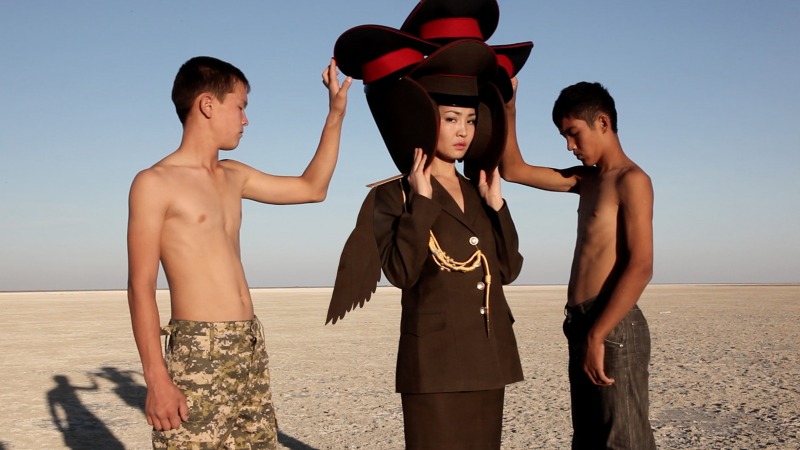
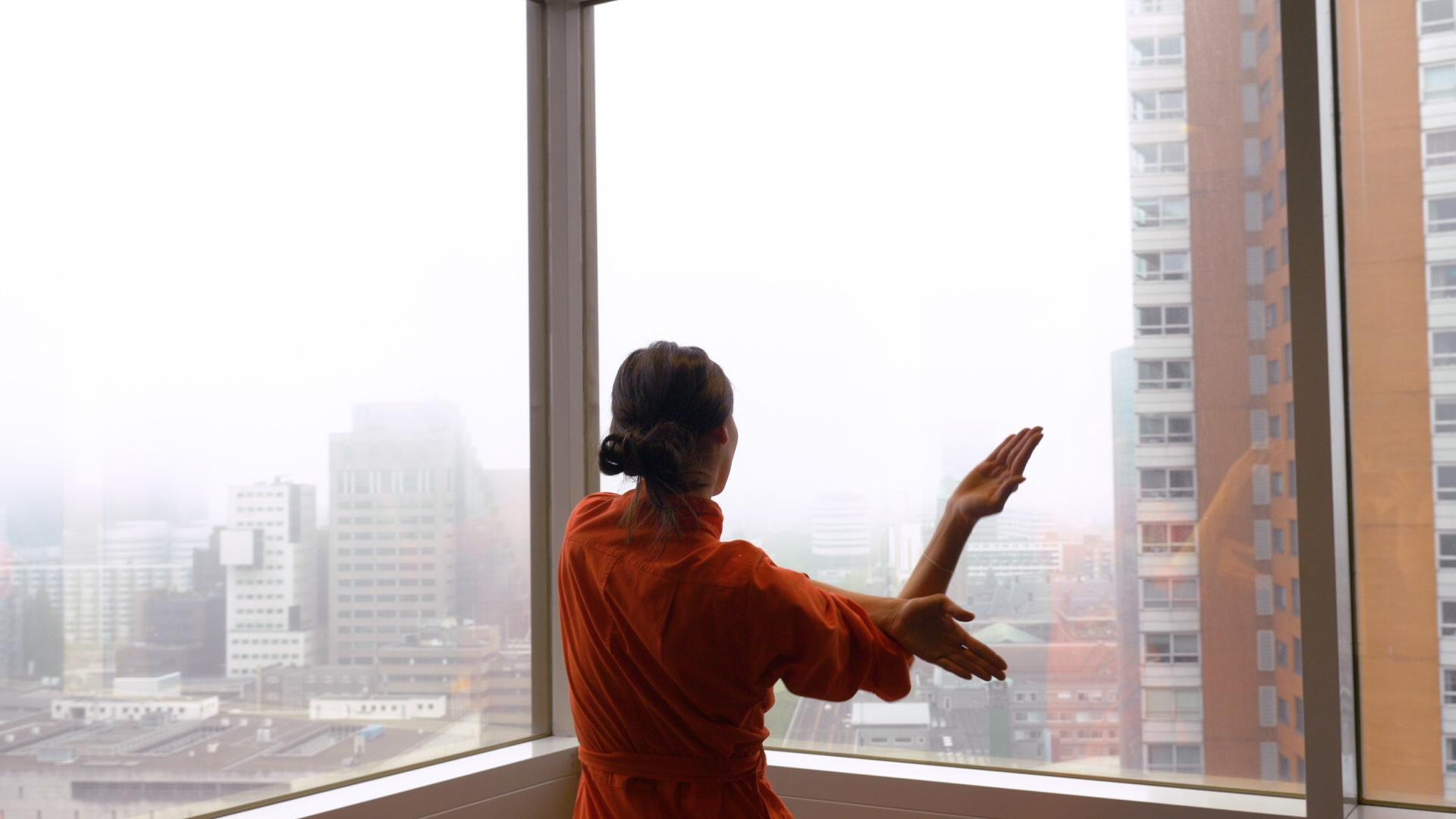
The six artists presented in this exhibition all refer to monumental buildings of the modernist era, focusing on how we adopted the successes and failures of modernism and how it has influenced our lives today in the way we see and measure our social behaviors. These works depict how architecture emphazises a sense of our cultural belonging and critically questions the brutalism and pragmatism in the architecture of the modernist era. The artists test the performative nature of buildings, using them as a source of inspiration to visualize the possibilities of our surroundings in a new way. From the Helsinki Olympic Stadium where Saara Ekström staged a performance inspired by Japanese Butoh dance, through the Aarhus City Hall in Denmark used by Jasmina Cibic for an adaptation of Bartók's pantomime The Miraculous Mandarin to Elina Brotherus’ action using the escalator of the Centre Pompidou in Paris, inspired by Marcel Duchamp's painting. Anri Sala and Józef Robakowski put on stage Le Corbusier's idea of architecture as a model for mass housing and a vision for a new vertical city, choosing housing projects "Long Sorrow" in Berlin and "Manhattan" in Łódź, Poland. All these buildings stand as landmarks for the modernist utopia and their architects' pragmatic idealism and puristic aspirations. Modern architectural remains require constant representation and documentation in order to recode and understand what this era left behind – just as Bauman calls for rethinking the framing concepts we use to narrate human experience and history.

Artists: Elina Brotherus | Jasmina Cibic | Saara Ekström | Józef Robakowski | Anri Sala | Héctor Zamora
Curated by: Asia Zak Persons

Photo credits: Saara Ekström: Amplifier (2017), film still
Jasmina Cibic: Nada: Act II (2017), film still